




Fall Flags vs. Fall Bunting: Which Is Best for Your Seasonal Decor?
Nov 3rd 2026
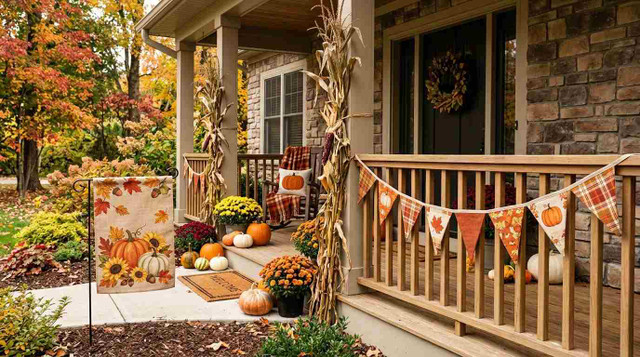
Outdoors, Halloween bunting works along a porch rail, across a porch header, between fence posts or framing a gate. Light determines whether it succeeds, because most of it is seen after dark, which changes what reads and where light needs to be. It stays up for about two weeks beside a path children walk, so how it is fixed matters more than how it is styled. Below are placements by location, then what makes them work.
Porches: Rails, Posts and Headers
The porch is the main outdoor surface for Halloween bunting because it is lit, sheltered and where every visitor walks up. Four placements work well:
- The top rail. A continuous run along the rail is the usual starting point.
- The header. A run along the beam across the front of the porch frames the door and sits where people naturally look.
- The posts. Vertical drops down the posts work in pairs rather than singly, so the porch reads as balanced from the street.
- Under the rail. On a deep porch, a second run below the top rail adds depth. Treat it as an option, not a default.
Because a porch is sheltered, lighter fixings are reasonable here, unlike on an open fence.
Fences, Gates and Yard Edges
Beyond the porch, each outdoor spot suits a different kind of run and behaves differently after dark.
|
Where |
The run that works |
After dark |
|
Fence line |
Repeated runs post to post, evenly spaced |
Usually unlit; plan light or accept daytime only |
|
Gate or entry |
A short run framing the opening |
First thing visitors see, so worth the effort |
|
Garage frontage |
A single long run across the top |
Catches car headlights and street light |
|
Deck or balcony rail |
Along the outer rail, facing out |
Light usually spills out from indoors |
|
Windows, from inside |
A run across the top of the glass |
Reads further down the street than outdoor runs |
What Changes Once It Is Dark
Halloween is a night display. Trick-or-treating happens after sunset, so most Halloween banners and decorations are seen and photographed in near-darkness, while nearly every other seasonal display is judged in daylight. That changes what works:
- Orange and black lose definition: In low light orange drifts toward brown and black merges with the shadows behind it, so a pattern that looked sharp at noon turns muddy.
- Silhouette carries further than pattern: Bold shapes and a clear outline against a lit wall or window read from the street; fine detail does not.
- Light placement decides what is seen: A porch light aimed at the door rather than the bunting leaves most of the work in shadow. If you add lighting near fabric, use only battery- or electric-powered lights.
Before calling anything finished, stand at the end of the path after dark and look back. This check matters and few people do it.
Hanging It So It Survives Two Weeks
A run of bunting is a sail. Late October often brings gusty autumn weather and a run held only at its ends catches every bit of it.
- Fix at intervals, not just the ends. Regular fixing points along the length stop it billowing.
- Keep exposed runs shorter. On a fence or open rail, several short runs handle wind better than one long one.
- Check the forecast first. Let the week's weather decide how much goes up and where.
- Bring it in before a storm. Taking pieces down ahead of high winds is easier than recovering them after.
Be proportionate. Two weeks is not a season, so a lighter fix is reasonable here where a longer fall or Christmas display would need more.
When it comes down, usually the first weekend of November, let everything dry fully before packing it and store it flat rather than stuffed into a box. A quick photo of the finished display saves time next year with minimal effort.
Keeping the Path Clear
A porch children can easily walk up to gets visited, so a clear route is part of what makes the display work. Some visitors will be very small and some will be wearing costumes or masks that limit what they can see.
- Nothing at head height across a walkway.
- Nothing trailing over a step or threshold. Loose ends and drooping runs catch feet.
- Nothing narrowing the route. Keep the full width of the path and steps open to the door.
- Enough light on the steps. Visitors need to see where they are stepping as well as what you have hung.
The same test applies here: walk the route yourself in the dark, at a child's pace.
About Independence Bunting
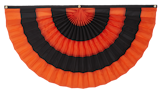
The company makes bunting, flags and banners and it makes and sells everything in America. Its Halloween pleated fans come in orange-and-black stripes and are fully sewn, not printed, with a choice of poly-cotton or nylon fabric.
Conclusion
Halloween bunting works outdoors along porch rails and headers, between fence posts and around gates, as long as it is planned for the dark and fixed for the wind. Light determines what visitors see, intervals along the run keep it in place and a clear path helps children reach the door. Before finishing, walk to the end of the path after sunset and look back. To plan your runs, browse Independence Bunting's Halloween pleated fans.
FAQs
How do you hang Halloween bunting on a fence?
Hang it in repeated runs from post to post, evenly spaced and keep the runs shorter where the fence is exposed to wind. Most fences are unlit after sunset, so a fence display is largely a daytime one unless you plan light for it.
What Halloween decorations show up best at night?
Silhouettes and high-contrast shapes show up clearly at night, along with anything lit from behind or hung inside a lit window.
Will Halloween bunting survive being left out most of the time?
It depends on how exposed it is to light and the weather that year. Wind is the main threat, since a loosely fixed run behaves like a sail. For other causes of outdoor wear, see our fall bunting post.
When should Halloween bunting come down?
Take it down on the first weekend of November. Let each piece dry fully before packing and store it flat rather than stuffed in a box.
How do you decorate outdoors without blocking the path?
Keep nothing at head height across a walkway, nothing trailing over a step and nothing narrowing the route to the door. Light the steps well enough to see them.