

American Flags Made in the USA: Materials, Construction, and Quality
Nov 3rd 2026
Three things affect how an American flag holds up outdoors: the fabric, how the stripes and stars are made, and how the hoist edge is finished. Outdoor flags are usually made from nylon, polyester, or cotton, and each works best in different situations. The federal government has a construction standard for the flags it buys, and those features are a good way to judge any flag. These details help you compare flags that might look the same at first glance.
The Three Things That Decide Flag Quality
Flag quality depends on the fabric, how the design is made, and how the edges are finished. Everything else is based on these three factors.
-
Fabric: The material affects the flag’s weight, how it flies, and how it stands up to wind and rain.
-
Construction: Sewn stripes and embroidered stars last differently outdoors compared to printed designs.
-
Finishing: The heading, grommets, and stitching at the free end affect where the flag starts to wear out.
You can’t see these three details in a product photo, so two flags at different prices might look the same online. Where a flag is made is a different topic, which we cover in our post about the Made in USA standard.
Nylon, Polyester, and Cotton Compared
Each fabric works well in some situations and not as well in others.
|
Material |
Suits |
Less suited to |
|
Nylon |
Light and moderate wind; flies easily and dries quickly |
Constant high wind and heavy exposure |
|
Two-ply polyester |
High wind and exposed sites; heavier and more robust |
Light breezes, where it may hang rather than fly |
|
Cotton |
Indoor display, ceremonies, and presentation |
Sustained outdoor exposure and wet weather |
If the weather is bad, the U.S. Flag Code suggests using only an all-weather flag. For private citizens, the Code is just a guideline and there are no penalties.
The best material depends on where and how often you plan to fly your flag, not on which fabric is better overall.
Sewn, Embroidered, or Printed
There are three main ways to create a flag’s design.
-
Printed: The entire design is printed on one piece of fabric. This method costs less, and the color stays on the surface.
-
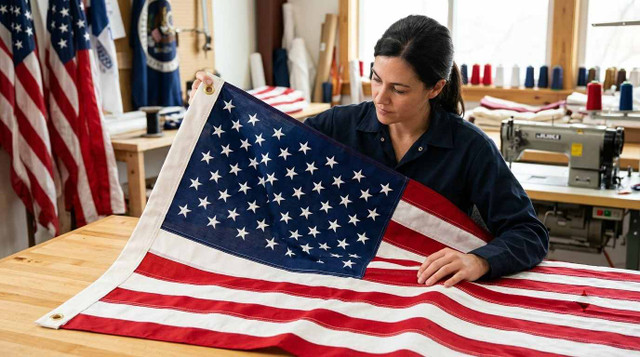
Sewn stripes: Each stripe is a separate piece of fabric sewn together, so the flag is made from fabric instead of just printed ink.
-
Embroidered stars: The stars are stitched into the blue area instead of being printed, and they appear on both sides of the flag.
For outdoor flags, you’ll notice the difference in two ways: how well the color lasts over time and how the fly end holds up when it starts to fray.
The Heading, the Grommets, and the Fly End
A flag’s construction also includes details that affect how strong and durable it is.
-
The heading: This reinforced band runs along the hoist edge. The federal specification calls for a cotton duck heading made from 2-ply yarn.
-
The grommets: These metal eyelets are where you attach the halyard. Solid brass grommets resist rust, but plated ones can corrode if their coating wears off.
-
The fly end: This is the flag’s loose edge, which gets worn out over time. Extra rows of stitching here can show that the flag is well made.
The specification also describes a heading design that uses a distance line, ring, and snap hook.
What the Federal Specification Calls For
The construction standard for flags bought for federal use is Federal Specification DDD-F-416F, dated March 31, 2005. It replaced the 1981 DDD-F-416E, and the General Services Administration has authorized all federal agencies to use it. Sellers often label flags built to it as "G-Spec."
The specification calls for:
-
Fabric: Cotton bunting; lightweight or heavyweight nylon bunting; nylon and wool bunting; or rayon banner cloth.
-
Stars: Appliquéd or Schiffli embroidered; Swiss hand loom embroidery is for indoor flags only.
-
Thread: Polyester sewing thread, with nylon thread allowed as an alternate on nylon fabric.
-
Heading: 2-ply cotton duck weighing at least 8.25 ounces per square yard.
-
Proportions: A hoist-to-fly ratio of 1.0 to 1.9, set for executive agencies by Executive Order 10834.
This is a procurement standard for government use. A flag built to different dimensions or with a different finish is not defective; it is built for a different purpose. Where a flag is made is a separate standard, covered in our post on Made in America flags.
About Independence Bunting
The company makes flags, banners, and bunting, and everything is made and sold in America. They offer U.S. outdoor, indoor, military, state, and specialty flags.
Outdoor U.S. flags are available in nylon, 2-ply polyester, and cotton. Printed nylon and cotton flags are listed separately.
Conclusion
A flag’s quality depends on details you usually can’t see in a photo. Choose the fabric based on where you’ll use the flag: nylon for light and moderate wind, two-ply polyester for windy spots, and cotton for indoor display. Look for sewn stripes and stitched stars, and check the fly end and heading before buying. The federal specification is a good way to judge any flag. To compare fabrics and construction, take a look at Independence Bunting’s outdoor U.S. flags.
FAQs
What is the best material for an outdoor American flag?
It depends on where you’ll use it. Nylon works well in light and moderate wind and flies easily. Two-ply polyester is best for exposed, windy places. Cotton is better for indoor display and ceremonies.
What is the difference between a sewn and a printed flag?
On a sewn flag, each stripe is a separate piece of fabric sewn together, and the stars are usually embroidered or appliquéd. On a printed flag, the entire design is printed on one piece of fabric.
What is a G-Spec flag?
G-Spec is a term sellers use for flags made to Federal Specification DDD-F-416F, which is the standard for flags bought by the federal government. This standard sets rules for the fabric, stars, thread, and heading.
Why does my flag fray at the end?
The fly end is the loose edge of the flag and gets the most movement in the wind, so it wears out first. Extra rows of stitching at the fly end help slow down fraying.
What size flag do I need for my pole?
Start by looking at your pole’s height. Flags are made to a set hoist-to-fly ratio, so the width and length change together. Compare the size listed for each flag style to your pole.